


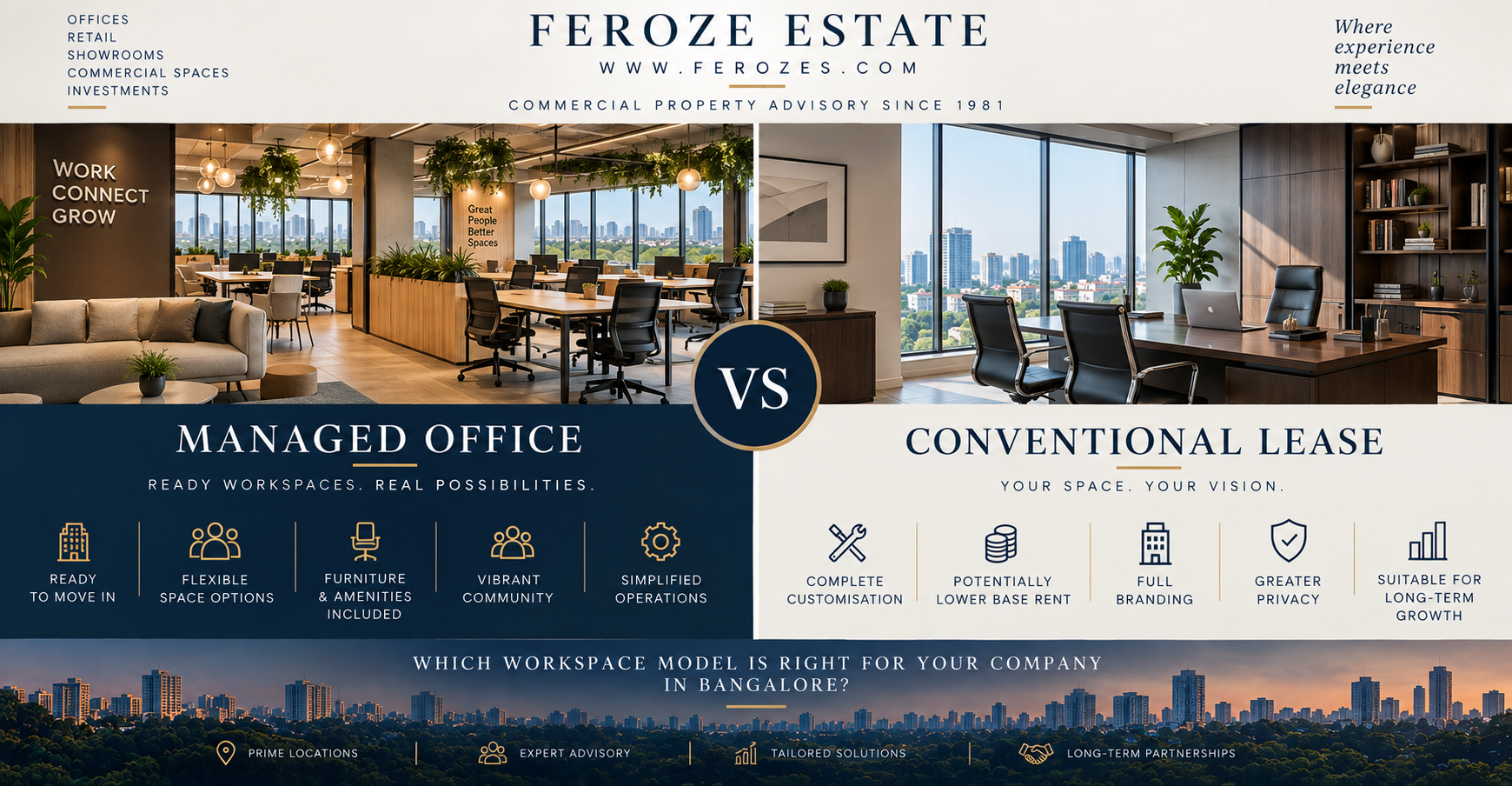
Companies looking for office space in Bangalore increasingly have two very different options:
- a managed office
- a conventional office lease
Both can work well, but the right choice depends on how quickly the company needs to move, how much control it wants over the workspace, how long it plans to stay and how much capital it wants to invest upfront.
What is a managed office?
A managed office is usually delivered as a ready-to-use workplace.
The operator may provide:
- furniture
- workstations
- meeting rooms
- reception
- internet
- housekeeping
- maintenance
- utilities
- pantry
- common areas
- office management
The tenant generally pays a bundled monthly amount instead of separately managing every element of the office.The exact inclusions vary by operator, so occupiers should confirm what is covered in the quoted monthly charge.
This can make occupation much faster and simpler.
Why managed offices have changed expectations
A few market leaders in the co-working and managed-office industry have raised the standard significantly when it comes to interior design, atmosphere, amenities and community.
Many modern managed offices now offer:
- premium contemporary interiors
- well-designed lounges
- meeting and collaboration spaces
- cafés and breakout areas
- strong reception areas
- community events
- a more energetic workplace atmosphere
As a result, employee expectations have changed.
Even companies considering a conventional lease increasingly want their office to feel more like a premium managed workspace rather than a traditional corporate office.
The benchmark is no longer simply:
“Is the office functional?”
It is increasingly:
“Is this a place people actually want to come to work?”
This has pushed both occupiers and landlords to think much more carefully about workplace experience.
What is a conventional office lease?
In a conventional lease, the tenant leases the office directly from the landlord.
The tenant usually takes greater responsibility for:
- fit-out
- furniture
- technology
- maintenance
- utilities
- housekeeping
- office operations
This gives the company much more control over the workspace, but it also requires more time, capital and management.
Managed offices can look more expensive — but include more
A managed office may appear expensive when compared only on a monthly rent or per-seat basis.
But that price often includes costs that a conventional tenant would otherwise pay separately, such as:
- furniture
- fit-out
- internet
- electricity
- maintenance
- housekeeping
- reception
- meeting-room infrastructure
- office management
A conventional lease may have a lower headline rent, but the tenant must calculate the full occupancy cost.
The right comparison is therefore not:
managed-office price vs base rent
It is:
managed-office price vs rent + fit-out + furniture + operations + utilities + maintenance
Speed of occupation
This is one of the biggest advantages of managed offices.
A company may be able to move into a managed workspace very quickly.
A conventional office can take significantly longer if the tenant needs to:
- design the office
- appoint contractors
- complete fit-out
- install furniture
- arrange internet and IT
- complete approvals
For companies that need space urgently, managed offices can be very attractive.
Flexibility
Managed offices can also offer greater flexibility.
Depending on the operator and agreement, companies may find it easier to:
- increase seat count
- reduce space
- add meeting rooms
- move within the same centre
- take shorter commitments
A conventional lease is usually more structured and may include a longer lease term and lock-in.
Branding and control
This is where conventional leases can have an advantage.
A company taking its own office can control:
- layout
- branding
- reception
- design
- security
- meeting rooms
- culture
- access
Managed offices may still allow branding and dedicated private areas, but the environment is often partly shared.
For companies where privacy, identity or client experience is critical, a conventional lease may be preferable.
Privacy and confidentiality
This can be an important issue for:
- financial businesses
- legal firms
- consulting companies
- family offices
- businesses handling confidential information
A dedicated conventional office can provide greater control over privacy and access.
Premium managed offices can also provide private suites, but occupiers should review the exact setup carefully.
Which companies may prefer managed offices?
Managed offices may suit:
- startups
- growing companies
- project teams
- companies entering Bangalore for the first time
- businesses needing quick occupation
- companies that want lower upfront capital expenditure
- occupiers uncertain about future headcount
Which companies may prefer a conventional lease?
A conventional lease may suit:
- established companies
- large occupiers
- businesses planning a long-term presence
- companies wanting complete control over design
- occupiers with specific security or privacy requirements
- businesses willing to invest in their own fit-out
Feroze Estate’s perspective
Feroze Estate Agency has advised companies and property owners in Bengaluru since 1981.
In our experience, the choice between a managed office and a conventional lease depends on four main questions:
- How quickly does the company need to move?
- How much capital does it want to invest upfront?
- How much control does it need over the workplace?
- How certain is it about future headcount?
Managed offices offer convenience, speed and flexibility.
Conventional leases offer greater control, identity and long-term customisation.
The better option is the one that fits the company’s operating model, not simply the one with the lower monthly number.
For companies evaluating office space in Bengaluru, Feroze Estate can assist with property identification, commercial comparison, negotiations and lease advisory.

Pingback:Co-working vs Serviced Office in Bangalore - Feroze Estate