


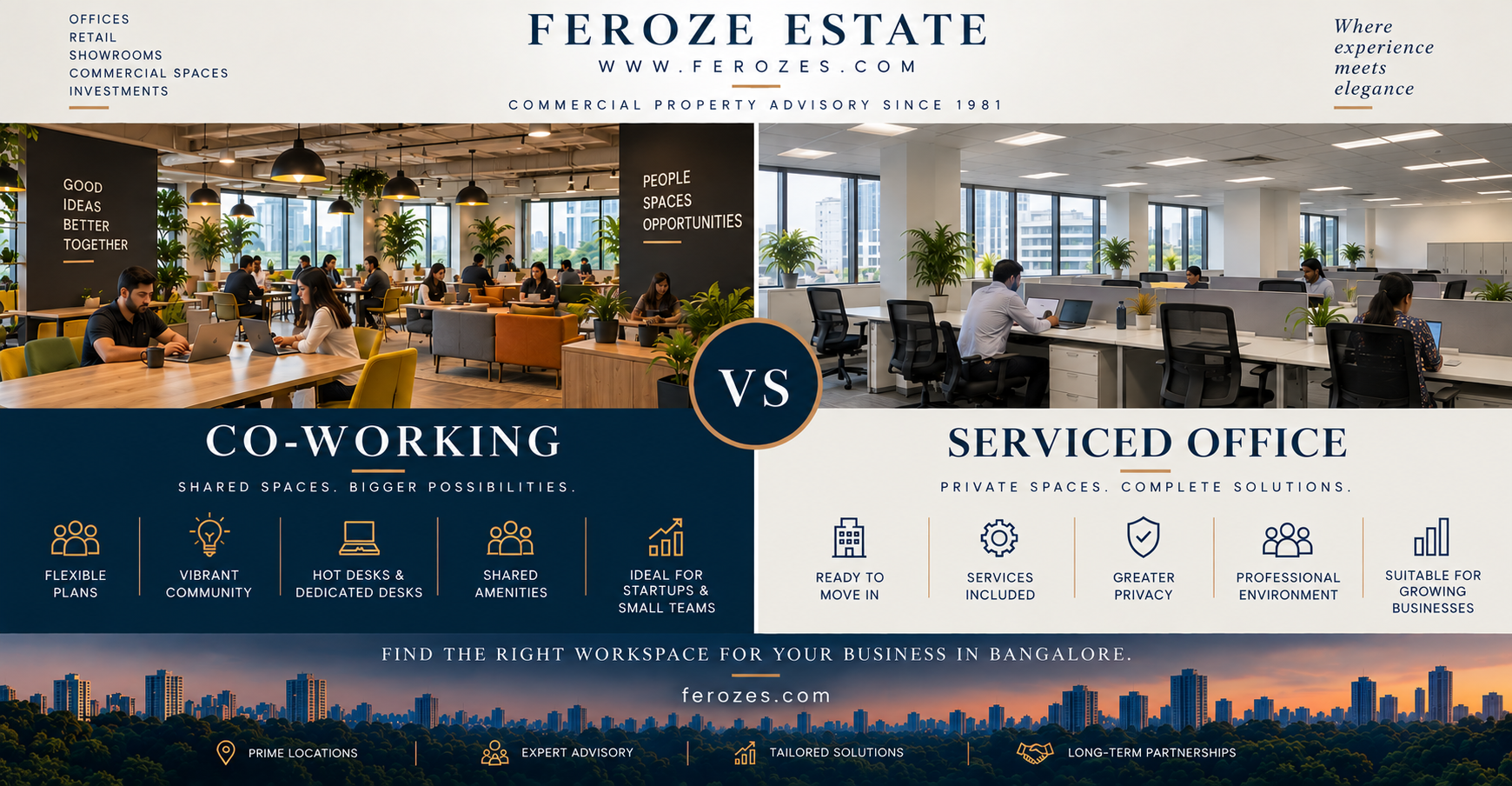
The terms co-working and serviced office are often used interchangeably, but they are not exactly the same.
A managed office can also sit somewhere between these models, depending on the operator and level of customisation.
Both offer ready-to-use office space with services included, but they differ in the level of privacy, flexibility, community and control they provide.
For companies looking for office space in Bangalore, understanding the difference can help avoid choosing the wrong workspace model.
What is a co-working space?
A co-working space is generally built around a shared workplace environment.
It may offer:
- hot desks
- dedicated desks
- small private cabins
- meeting rooms
- lounges
- shared pantry areas
- common reception
- events and community activities
One of the biggest attractions is flexibility.
Companies can often start with a small number of seats and expand as their team grows.
Co-working is particularly attractive to:
- startups
- freelancers
- project teams
- satellite offices
- small companies
- businesses that value networking and community
What is a serviced office?
A serviced office is typically a private, fully fitted office suite that is already operational.
The operator generally provides services such as:
- furniture
- internet
- housekeeping
- reception
- utilities
- maintenance
- meeting-room access
- office management
The key difference is that serviced offices traditionally place more emphasis on privacy and dedicated space than co-working.
They are often suitable for:
- professional firms
- consultants
- overseas companies entering Bangalore
- smaller corporate teams
- businesses that want a ready office without managing fit-out or operations
The difference is becoming less obvious
The distinction between co-working and serviced offices is becoming increasingly blurred.
Many premium co-working operators now offer:
- private suites
- dedicated floors
- customised offices
- branding
- restricted access
- premium meeting rooms
At the same time, serviced-office operators have adopted many of the design, hospitality and amenity standards that made modern co-working popular.
So the difference is no longer simply:
shared space vs private office
It is more about:
- how much space is dedicated to you
- how much privacy you need
- how much branding/control you want
- how much flexibility you need
- what services are included
Why co-working has become so attractive
Some leading co-working operators have raised expectations dramatically when it comes to interiors, atmosphere, amenities and community.
Modern co-working spaces can offer:
- high-quality design
- lounges
- cafés
- breakout areas
- collaboration spaces
- events
- community engagement
For employees, this can create a workplace that feels more energetic and social than a traditional office.
For companies trying to attract talent, that workplace experience can be a real advantage.
Privacy and branding
This is one of the biggest areas of difference.
Co-working can involve more shared areas and a more visible community environment.
A serviced office generally provides a more private setting and can feel closer to a traditional corporate office.
For businesses that regularly meet clients or deal with confidential matters, this may be important.
Examples include:
- financial firms
- legal practices
- consultants
- family offices
- professional services businesses
Cost structure
Both models can include bundled services.
The monthly charge may include:
- rent
- furniture
- internet
- utilities
- housekeeping
- maintenance
- reception
- common-area access
But inclusions vary by operator.
Occupiers should confirm exactly what is included before comparing prices.
A cheaper monthly quote may exclude services that another operator includes.
Flexibility
Co-working usually offers stronger flexibility when it comes to:
- adding seats
- reducing seats
- short-term commitments
- moving between centres
- using shared facilities
Serviced offices can also be flexible, but agreements may be more structured depending on the size and level of customisation.
Which one is right for your company?
Co-working may suit:
- startups
- small teams
- freelancers
- companies prioritising flexibility
- businesses that value community
- teams that want a modern social workplace
Serviced offices may suit:
- professional firms
- consultants
- smaller corporate teams
- businesses requiring privacy
- overseas companies entering Bangalore
- companies that want a ready office with a more corporate environment
Feroze Estate’s perspective
Feroze Estate Agency has advised companies and property owners in Bengaluru since 1981.
In our experience, the right choice depends on four things:
- team size
- privacy requirements
- flexibility
- workplace experience
A co-working space can offer community and flexibility.
A serviced office can offer more privacy and a stronger corporate identity.
Today, the best operators often combine elements of both.
For companies evaluating co-working, serviced offices or conventional office space in Bengaluru, Feroze Estate can assist with property identification, comparison, negotiations and lease advisory.
