


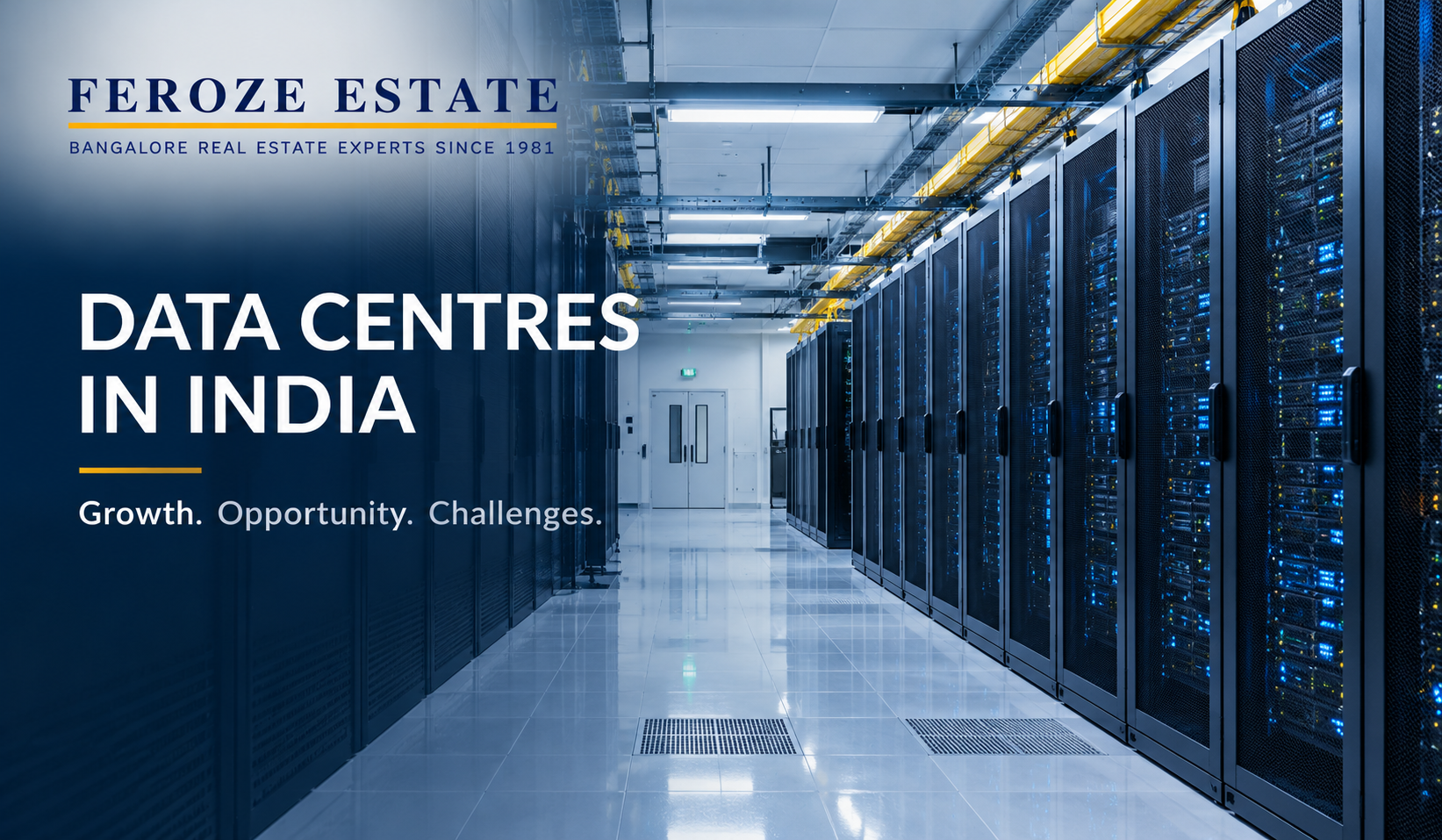
Growth, Opportunities and Challenges
Introduction
Behind every digital payment, cloud application and artificial intelligence (AI) service lies physical infrastructure that stores and processes information. Much of this infrastructure operates inside data centres.
India’s expanding digital economy is driving demand for these specialised facilities, attracting investment in land, buildings, electricity infrastructure, cooling systems and connectivity.
However, data centres require much more than space. Reliable power, suitable locations, fibre connectivity, cooling and sustainable resource management are essential to their success.
Understanding both the opportunities and challenges is crucial to evaluating this growing industry.
What Is a Data Centre?
A data centre is a specialised facility housing servers, storage systems and networking equipment that process and manage digital information.
Unlike conventional office buildings, data centres are designed around continuous operations, power reliability, cooling, security and connectivity.
They support cloud computing, banking, e-commerce, enterprise software, streaming services, government platforms and AI applications.
Different facilities have different requirements. A smaller enterprise data centre may have very different power, cooling and land needs from a large cloud or AI facility.
Why Are Data Centres in India Growing?
Several factors are driving demand.
1. Cloud Computing
Businesses increasingly use cloud platforms instead of maintaining all their computing infrastructure themselves. As cloud adoption grows, providers need additional capacity to serve customers reliably.
2. Artificial Intelligence
AI workloads require substantial computing power and can generate significant heat. This is creating demand for advanced servers, high-capacity electrical systems and more sophisticated cooling technologies.
3. Digital Services
Digital payments, online shopping, streaming, mobile applications and enterprise platforms all depend on reliable data infrastructure. As these services expand, so does the need for computing and storage capacity.
4. Data Governance and Security
Businesses must consider data protection, security and regulatory obligations when deciding where information is processed and stored. Depending on the applicable rules and industry, these considerations can influence data-centre location decisions.
5. Investment and Government Support
India has introduced measures to support digital infrastructure and attract investment.
A Government of India briefing published in August 2026 reported installed data-centre capacity of approximately 1.57 GW, compared with around 375 MW in 2020. Future capacity projections vary, however, and should be treated as estimates rather than guaranteed outcomes.
Source: Government of India — Status of Data Centres in India
Which Locations Are Attracting Investment?
India’s data-centre market includes established and emerging locations such as Mumbai and Navi Mumbai, Chennai, Hyderabad, Bengaluru and Delhi NCR.
Each offers a different combination of customer demand, connectivity, land availability, power infrastructure and development costs.
Key location factors include:
- Reliable electricity supply and available grid capacity.
- Access to high-quality fibre connectivity.
- Suitable land and permitted development use.
- Cooling requirements and water availability.
- Flood exposure, climate and environmental risks.
- Approval processes and infrastructure delivery timelines.
A technology hub may offer access to customers and skilled professionals, but that alone does not make every site suitable. Similarly, inexpensive land may prove costly if power connections or approvals are difficult to secure.
For commercial land and infrastructure-led real-estate opportunities in Bengaluru, these location fundamentals provide an important early screen; specialist engineering and technical feasibility should be assessed separately.
What Are the Main Challenges?
1. Electricity Requirements
Data centres require continuous power. Developers must assess actual grid capacity, connection timelines, backup systems and redundancy—not merely whether an electricity line is nearby.
2. Water and Cooling
Servers generate heat that must be removed continuously. Depending on the design, facilities may use air cooling, water-based systems or liquid cooling.
Water availability is particularly important in regions facing scarcity. Cooling technology and resource requirements should be assessed before a site is selected.
Research published by CEEW in 2026 highlights the growing relationship between India’s data-centre expansion, electricity demand and water use.
Source: CEEW — Data Centres, Power and Water Use in India
3. Land Suitability
A large plot does not automatically qualify as a data-centre site. Developers must consider land-use permissions, access, drainage, environmental constraints, fibre connectivity and the feasibility of supplying sufficient electricity.
4. High Investment and Operating Costs
Data centres require substantial investment in construction, electrical systems, cooling, security and technology. Electricity, maintenance and specialist staffing also contribute to ongoing costs.
Project viability depends on factors such as energy prices, customer commitments, utilisation and the time required to become operational.
5. Approvals and Delays
Projects may require permissions relating to land use, building plans, fire safety, electricity connections and other applicable regulations. Delays can occur when approvals, utility upgrades and construction schedules are not coordinated.
India’s Data Centre Evaluation Framework, announced in October 2026, highlights power, water, environmental sustainability, economic value and implementation readiness as important considerations.
Source: Government of India — Data Centre Evaluation Framework
Can Data Centres Grow Sustainably?
Sustainable expansion requires more than adding computing capacity. Developers must consider the long-term impact on energy systems, water resources and surrounding communities.
Important measures include:
- Improving the energy efficiency of servers, electrical systems and cooling equipment.
- Using renewable energy where feasible while maintaining reliable supply.
- Selecting cooling systems suited to the site’s climate and water availability.
- Assessing water risks before committing to a location.
- Planning for flooding, extreme heat and operational disruptions.
- Monitoring energy consumption, water use and environmental performance.
These considerations are becoming increasingly important as facilities grow larger and AI workloads demand more computing power.
What Does This Mean for Commercial Real Estate?
Data centres create specialised real-estate opportunities, but their requirements differ significantly from those of conventional offices and commercial buildings.
Landowners and developers should assess several factors before considering a property for this purpose:
- Is the proposed use permitted under the applicable planning framework?
- Can sufficient electricity capacity be secured?
- Are fibre connectivity and cooling requirements achievable?
- Does the site offer suitable access, drainage and resilience?
- Are approvals and development costs commercially viable?
These factors can influence a property’s suitability, development cost and potential value.
For a broader overview of commercial property decisions in Bengaluru, explore our commercial real estate advisory in Bengaluru.
For landowners, the key lesson is simple: land size alone does not determine a site’s potential for data-centre development. Utilities, connectivity, permissions and long-term operating requirements are equally important.
Early technical and commercial due diligence is therefore essential before making investment decisions.
Conclusion
India’s data-centre industry is expanding alongside cloud computing, AI and the wider digital economy. This creates opportunities across technology, construction, energy and commercial real estate.
However, long-term growth will depend on reliable electricity, suitable land, effective cooling, water management, connectivity and timely project execution.
For investors, operators and landowners, understanding these requirements is essential to distinguishing genuine opportunities from projects that may face significant infrastructure or commercial challenges.
As India’s digital economy evolves, the locations best equipped to support reliable and sustainable data-centre operations are likely to play an increasingly important role in the sector’s development.
