

FEROZE ESTATE | BENGALURU REAL ESTATE INSIGHT
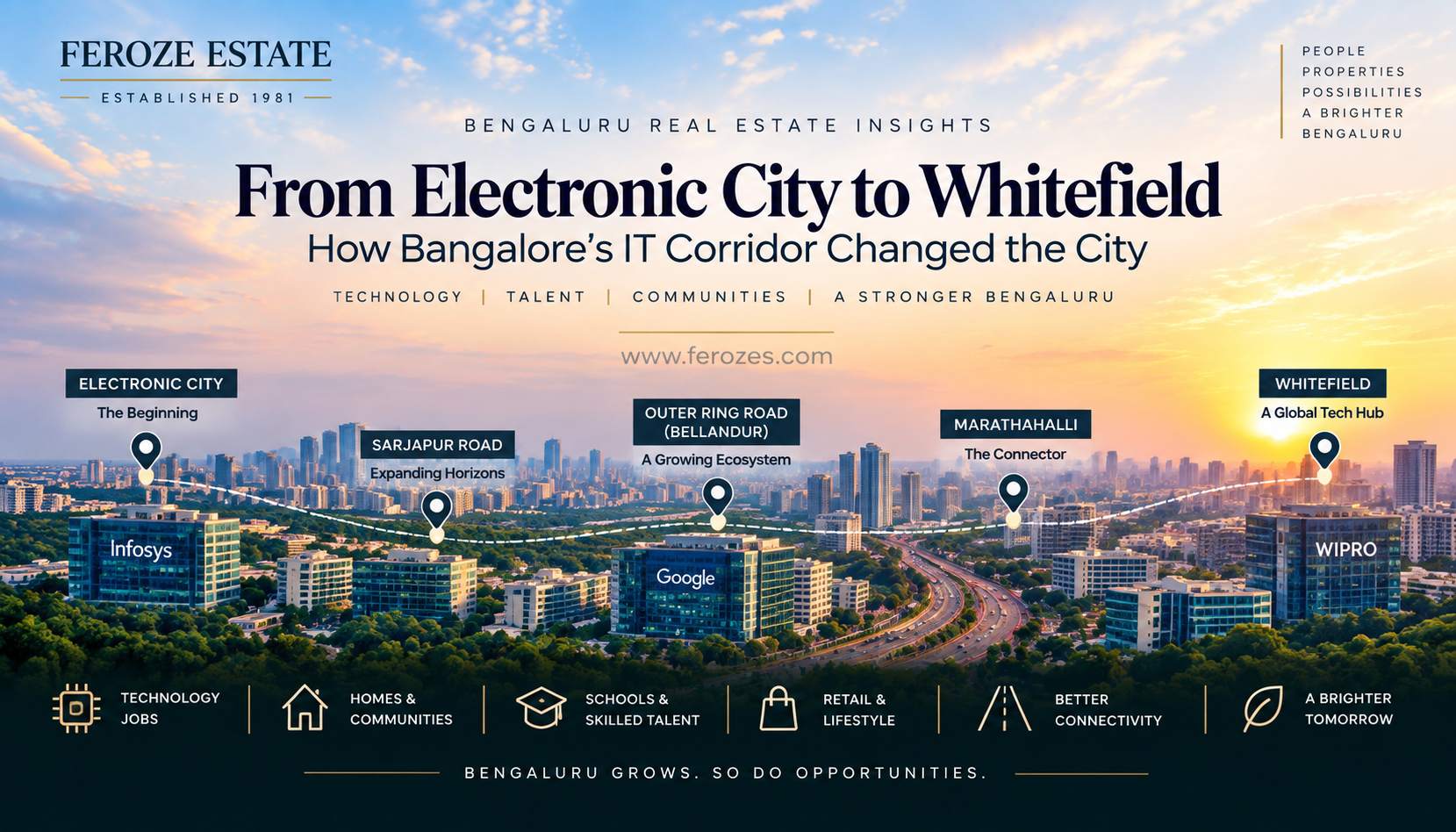
When people speak about Bangalore’s “IT corridor”, they often refer to Whitefield, Marathahalli, Outer Ring Road, Bellandur and Sarjapur Road.
But Bengaluru’s technology story did not begin in any one of these locations.
It developed over several decades and across several distinct parts of the city.
Electronic City came first. Then came the infrastructure that allowed software to be developed and exported from India. Whitefield and ITPL created another major technology district. Later, Marathahalli, Mahadevapura, Outer Ring Road, Bellandur and Sarjapur Road evolved into one of the largest concentrations of technology employment in the country.
The result was not merely an office-market boom.
Technology employment fundamentally changed where Bengaluru residents live, where developers build homes, where schools and hospitals locate, where retail follows and how people evaluate the value of commute time.
To understand Bengaluru real estate today, it helps to understand how this technology corridor was created.
1. Bangalore’s technology geography began with Electronic City
Long before Whitefield became synonymous with IT, Karnataka had already begun planning a dedicated electronics district south of the city.
KEONICS, established in 1976, planned what became Electronic City and acquired approximately 332 acres along Hosur Road for the development. Over time, the district attracted companies including Wipro, Infosys, Hewlett-Packard, Siemens, Motorola and Tata-related businesses. Keonics
This was an important change in Bengaluru’s urban geography.
Technology companies no longer needed to be concentrated around the traditional central business district. Large campuses could be created on the outskirts of the city, with dedicated infrastructure and room for expansion.
That model would later be repeated across Bengaluru.
Electronic City therefore represents more than an employment district.
It was one of the first examples of technology creating an entirely new real-estate destination outside traditional Bangalore.
2. Texas Instruments helped prove global technology work could be done from Bangalore
A major turning point came in 1985, when Texas Instruments established its Bangalore operation.
Texas Instruments describes itself as the first multinational company to establish a software design centre in India. Its Bangalore centre also used satellite communications to export software overseas. Texas Instruments
This was significant for Bengaluru.
At the time, India’s technology industry did not have today’s high-speed global communications infrastructure. Demonstrating that sophisticated technology and design work could be performed in Bangalore and delivered internationally helped validate the city as a location for global engineering.
In many ways, the modern Global Capability Centre story that Bengaluru is known for today has roots in developments such as these.
3. Infosys helped make Electronic City a symbol of Indian technology
Infosys was founded in Pune in 1981 but relocated its corporate headquarters to Bangalore in 1983.
In 1994, the company opened its first campus in Electronic City. Infosys records describe the original campus as just two buildings on a five-acre property; it later expanded substantially and historically accommodated more than 25,000 employees. Infosys
That campus became one of the most recognisable symbols of India’s software-services industry.
Electronic City subsequently grew into a major employment district with technology companies, supporting businesses and a significant residential population around it.
The relationship between offices and housing that developed here would later become visible across other Bengaluru technology corridors.
4. Software Technology Parks changed the economics of exporting software
Technology companies alone could not have built the ecosystem.
Infrastructure mattered.
The Government of India established Software Technology Parks in Bengaluru, Pune and Bhubaneswar around 1989–90, with the centres later brought together under Software Technology Parks of India in 1991. STPI
STPI-Bengaluru subsequently introduced satellite-based data communication services in 1992. It also supported international connectivity and software exports at a time when such infrastructure was far more difficult for individual companies to obtain. STPI
This is an important part of Bengaluru’s story.
The technology boom was not simply the result of companies choosing a pleasant city with good engineers.
It was the combination of:
- engineering talent
- public policy
- telecommunications infrastructure
- dedicated technology zones
- private investment
- global demand for software and engineering services
These elements began reinforcing one another.
5. Whitefield and ITPL created the next major technology district
The next major geographic shift occurred to the east.
The International Tech Park Bangalore, still widely referred to by Bangaloreans as ITPL and officially known today as ITPB, helped transform Whitefield.
The project was created through a partnership involving Singapore investors, Tata Industries and the Karnataka government. By 1997–98, its first phase was nearing completion, with companies preparing to occupy the development. Business Standard
Today, CapitaLand describes International Tech Park Bangalore as a 69-acre integrated development combining offices with retail, hospitality and other amenities. CapitaLand
This was important because ITPL was not simply an office building.
It demonstrated the potential of an integrated technology district.
Companies could locate together within a purpose-built environment supported by communications infrastructure, services and amenities.
As employment increased, Whitefield began changing around it.
6. Whitefield became much more than an office destination
The expansion of the technology industry gradually transformed Whitefield from an outer Bengaluru location into a major urban centre.
Thousands of employees working in and around Whitefield created demand for:
- apartments
- rental housing
- international and private schools
- hospitals
- shopping centres
- restaurants
- hotels
- entertainment
- neighbourhood retail
- additional office development
This is a pattern that would subsequently repeat across Bengaluru.
Jobs create demand for housing. Housing attracts services. Services make the area more liveable. Improved liveability attracts additional employers and residents.
Over time, the employment district becomes an urban market in its own right.
Transport infrastructure has strengthened this further.
In March 2023, the 13.71-km Whitefield (Kadugodi)–Krishnarajapura Metro extension opened as part of Bengaluru Metro Phase 2, improving rapid-transit access to the eastern employment district. Press Information Bureau
7. Marathahalli became valuable because of what surrounds it
Marathahalli’s role in Bengaluru’s technology geography is slightly different.
It was not created around one famous technology campus.
Its importance comes largely from its position between several major employment districts.
From the broader Marathahalli area, commuters can access:
- Whitefield
- Brookefield
- Mahadevapura
- Doddanekkundi
- Outer Ring Road
- Bellandur
- Sarjapur Road
This has made Marathahalli and adjoining areas particularly relevant to rental and residential demand.
An employee may work in Whitefield today but move to an employer on Outer Ring Road several years later.
Living somewhere that provides access to multiple employment clusters can therefore be more practical than choosing a home based on only one employer.
That flexibility is an important but sometimes overlooked driver of residential demand around Bengaluru’s technology corridors.
8. Outer Ring Road created a different type of technology district
The next phase of Bengaluru’s IT growth was different from Electronic City and ITPL.
Along the Marathahalli–Bellandur–Devarabeesanahalli–Sarjapur stretch of Outer Ring Road, individual campuses gradually formed a much larger continuous commercial corridor.
Large technology parks and business campuses brought together multinational technology companies, Indian IT companies, financial-services firms, consulting companies and increasingly Global Capability Centres.
Today major global technology companies maintain significant operations in this geography.
Microsoft, for example, lists Bengaluru offices at Ambalipura on Outer Ring Road as well as at Bagmane Capital Campus in Mahadevapura. Microsoft
Google’s current Bengaluru footprint provides another example.
9. Google shows how the eastern technology corridor continues to evolve
In February 2025, Google inaugurated Ananta, one of its largest offices globally, in Bengaluru.
Google describes Ananta as one of its most ambitious purpose-built campuses, designed around collaboration, research and product development. blog.google
The campus is located in Mahadevapura, positioning it firmly within eastern Bengaluru’s technology ecosystem. Google’s own office directory lists Ananta at Rio Business Park in Mahadevapura. About Google
And the company’s expansion continues.
In 2026, Google secured rights over approximately 2.6 million sq ft at Alembic City in Whitefield, including additional buildings reserved for possible future expansion. The Economic Times
That is an important signal.
Whitefield and the eastern IT corridor are not simply benefiting from technology investments made twenty years ago.
Major global companies are still making long-term commitments to the area.
10. Sarjapur Road developed around another technology anchor: Wipro
Sarjapur Road has its own technology history.
Wipro expanded deeply into information technology during the 1980s, began selling personal computers in India in 1985 and later developed its software-services business. Wipro
Today Wipro’s corporate headquarters remains at Doddakannelli, Sarjapur Road, where the company also maintains a development centre. Wipro
This helped establish Sarjapur Road as another important technology-linked corridor.
Its position also gives residents access toward several different employment zones:
- Bellandur
- Outer Ring Road
- Marathahalli
- Whitefield
- Electronic City
- southeast Bengaluru
The result has been extensive residential development alongside the growth of schools, hospitals, retail and hospitality.
11. Bengaluru does not really have one IT corridor anymore
This is perhaps the most important distinction.
Calling everything the “Bangalore IT corridor” is convenient, but Bengaluru today actually has multiple connected technology districts.
Electronic City represents one generation.
Whitefield and ITPL represent another.
Mahadevapura, Marathahalli, Bellandur and Outer Ring Road represent another stage of large-scale commercial development.
Sarjapur Road developed alongside them.
Other major employment centres have subsequently grown in north Bengaluru and elsewhere.
The city’s technology economy has therefore become polycentric.
Companies no longer need to locate in one traditional downtown.
Neither do employees.
And that has fundamentally changed Bengaluru property markets.
12. Which technology company employs the most people in Bangalore?
This is more difficult to answer than it might appear.
Most major technology companies disclose either their global workforce or their India workforce, but not the exact number working in Bengaluru.
One of the strongest city-specific figures publicly available is from Tata Consultancy Services.
In early 2025, TCS said that it already had approximately 70,000 employees working across its Bengaluru offices, while discussing plans to create capacity for an additional 25,000 seats in Whitefield. The Economic Times
That makes TCS one of the largest documented technology employers in Bengaluru.
It may well be among the city’s very largest individual corporate workforces, but we would not describe it as definitively the single largest because comparable Bengaluru-only numbers are not publicly disclosed by every major employer.
The number itself nevertheless demonstrates the extraordinary employment scale of the city’s technology industry.
13. Why do employees increasingly choose to live near these technology hubs?
The answer is not simply that Whitefield or Bellandur has new apartments.
It is largely about time.
A Bengaluru professional may spend hundreds of hours each year commuting.
Living closer to an employment cluster can therefore materially affect quality of life.
That means an employee working in Whitefield may prioritise Whitefield, Brookefield or nearby east Bengaluru.
Someone working along Outer Ring Road may consider Bellandur, Marathahalli or surrounding neighbourhoods.
Someone working around Doddakannelli may look toward Sarjapur Road.
Proximity also creates another advantage.
Employees are not only closer to their current company. They are closer to many potential future employers.
In an industry where professionals may change companies several times over their career, being surrounded by multiple employment centres provides residential flexibility.
This helps explain why housing demand tends to follow employment density.
14. Technology employment creates an entire property ecosystem
Once tens of thousands of well-paid professionals work within a relatively concentrated area, real estate development tends to follow.
First comes demand for housing.
Then demand grows for:
- supermarkets
- restaurants
- malls
- schools
- hospitals
- gyms
- hotels
- serviced apartments
- co-working centres
- entertainment
- neighbourhood offices
The original office district gradually becomes a complete urban economy.
This explains why places such as Whitefield are now fundamentally different from what they were several decades ago.
Technology did not simply raise demand for office space.
It helped create entire neighbourhoods.
15. The corridor’s success has also created its biggest challenge
Rapid growth brings consequences.
The concentration of offices and housing across east and southeast Bengaluru has put enormous pressure on roads and urban infrastructure.
Traffic congestion is therefore not separate from the real-estate story.
It is part of it.
In fact, congestion reinforces the importance of proximity.
If crossing the city during peak hours takes substantial time, employees become more willing to live near their employment district.
That is why transport projects such as the Whitefield Metro can materially influence property decisions.
The value of a home is not determined only by the number of kilometres between home and work.
In Bengaluru, travel time may matter more than distance.
16. What does the IT corridor mean for residential property?
Employment concentration creates a powerful base of housing demand.
But that does not mean every residential property near a technology park is automatically a good investment.
Within the same general corridor, properties can differ significantly based on:
- distance from employment centres
- road access
- metro accessibility
- traffic bottlenecks
- water and infrastructure
- project quality
- developer reputation
- maintenance
- surrounding development
- future housing supply
- schools and healthcare
- rental demand
A well-located apartment with strong connectivity and a good surrounding ecosystem may perform very differently from another property only a few kilometres away.
The employment story is therefore the starting point — not the complete investment case.
17. What does it mean for commercial property?
The technology corridor has also changed how companies evaluate office locations.
Employers increasingly consider:
- where their employees live
- access to public transport
- proximity to other technology companies
- availability of skilled talent
- future expansion space
- quality of the building
- power and technology infrastructure
- amenities
- travel time to the airport and other business districts
For companies recruiting technology professionals, location has become part of the talent strategy.
Businesses evaluating whether to lease or acquire their premises can also read our Rent or Buy an Office in Bangalore? guide.
This is one reason large technology clusters tend to reinforce themselves.
Once enough employers are present, the talent pool becomes deeper.
And once the talent pool becomes deeper, additional employers are attracted to the area.
We explored this broader corporate demand in our recent Bangalore Office Market 2026 analysis.
18. Central Bangalore and the IT corridor serve different requirements
The rise of the technology corridors did not make Central Bengaluru irrelevant.
Instead, Bengaluru developed multiple commercial markets serving different occupiers.
Central locations remain important for professional services, corporate headquarters, premium businesses, hospitality, retail and companies that value a prestigious central address.
Large technology and GCC occupiers, however, frequently require:
- much larger floor plates
- campus environments
- extensive parking
- expansion capacity
- modern Grade-A buildings
- employee amenities
Those requirements helped drive office development outward.
The city therefore evolved from a traditional centre-and-suburb model into a network of specialised business districts.
We recently explored this scarcity and location premium in our analysis of Central Bangalore property prices.
19. The next chapter may look different again
Bengaluru’s technology geography continues to evolve.
Artificial intelligence, semiconductor design, engineering R&D, cloud computing and Global Capability Centres are creating new categories of employment.
Google’s continued investment, large technology campuses and ongoing office expansion illustrate that Bengaluru remains strategically important to global technology companies. blog.google
At the same time, infrastructure will increasingly determine which areas capture the next phase of growth.
Metro connectivity, roads and access between employment clusters will influence both commercial and residential choices.
The next generation of Bengaluru property development will therefore be shaped not merely by where companies locate, but by how easily people can reach them.
Feroze Estate’s perspective
Feroze Estate has worked in Bengaluru real estate since 1981.
That means our journey through the city has occurred alongside Bengaluru’s own transformation.
When the business began, today’s vast technology corridors did not exist in their present form.
Electronic City was still developing.
Whitefield had not yet become one of India’s best-known technology districts.
Outer Ring Road had not become the corporate office corridor it is today.
Sarjapur Road had not experienced the scale of residential and commercial development that now surrounds it.
Over four decades, we have watched employment reshape Bengaluru.
The lesson is an important one for property owners, investors and businesses:
Real estate follows economic activity — but the strongest locations are usually those where employment, infrastructure, connectivity and quality of life reinforce one another.
Technology created the jobs.
The jobs created demand.
And that demand helped redraw the map of Bengaluru.
Looking for Property or Office Space in Bangalore?
Feroze Estate advises businesses, property owners, investors and occupiers across Bengaluru’s commercial real-estate markets.
Whether you are evaluating office space in Whitefield, Outer Ring Road, Sarjapur Road, Electronic City or another Bengaluru business district, our team can help assess the location, property and commercial terms in the context of the wider market.
Speak to Feroze Estate
www.ferozes.com
